From Patio to Pavilion: How to Extend Your Tech Outdoors
Picture this: a Saturday evening in late spring, the sun dipping behind the tree line, and a dozen guests settling into your outdoor pavilion for a private screening of a classic film. The speakers fill the air with rich, enveloping sound. The landscape lighting shifts from warm amber to a soft twilight blue without anyone touching a switch. A radiant heater kicks on the moment the temperature drops below 68°F. None of this happens by accident. It happens because someone thought carefully about how to extend tech outdoors, treating the space with the same precision and intentionality as the finest media rooms inside the home.
The gap between what’s possible indoors and what’s achievable under open sky has narrowed dramatically over the past few years. Weather-rated displays now rival studio monitors in color accuracy. Distributed audio systems designed for exterior use can fill a half-acre property with fantastic sound without a single visible speaker. And control platforms have matured to the point where your patio, pool deck, and pavilion can operate as a unified environment, responding to your preferences in real time. The question is no longer whether outdoor technology can match the indoor experience. It’s whether your outdoor space has been designed to take full advantage of what’s available.
Elevating the Outdoor Living Experience with Integrated Technology
For most of the 2000s and 2010s, “outdoor tech” meant a portable Bluetooth speaker and maybe a weather-resistant TV mounted under an eave. Those days are over. The outdoor living space has become a true extension of the home, and clients increasingly expect it to perform at the same level as their dedicated home theaters and whole-home audio systems.
What makes this possible in 2026 is the convergence of three things: commercial-grade hardware that’s been refined for residential use, control ecosystems that treat outdoor zones as first-class citizens alongside indoor rooms, and installation expertise that accounts for the unique challenges of sun, wind, moisture, and temperature swings. A patio isn’t a living room. Acoustic behavior changes when there are no walls to contain sound. Displays face direct sunlight that would wash out any consumer-grade screen. Network signals have to travel across open air and through building materials simultaneously.
The best outdoor installations don’t just survive the elements; they’re engineered around them. That means purpose-built infrastructure, professional acoustic modeling, and automation that adapts to conditions that your indoor systems never encounter. The following sections break down exactly what that looks like, component by component.
The Foundation: High-Performance Outdoor Network Infrastructure
Every piece of outdoor technology, from your display to your lighting to your motorized shades, depends on a reliable network. And outdoor networking is a fundamentally different challenge than indoor networking. You’re dealing with longer distances, physical obstructions like stone walls and pergola structures, and interference from neighboring properties. Skip this step or treat it as an afterthought and every system built on top of it will underperform.
A properly designed outdoor network uses a combination of hardwired backbone connections and strategically placed wireless access points. The goal is zero dead zones across the entire property, with enough bandwidth to support simultaneous 4K streaming, multi-zone audio, security cameras, and dozens of IoT devices without congestion.
Seamless Roaming with Enterprise-Grade Access Points
Consumer mesh systems from big-box stores simply aren’t built for this. They struggle with the distances involved, they can’t handle the device density, and they drop connections during handoffs between nodes. Enterprise-grade access points from manufacturers like Ruckus, Ubiquiti, or Cisco Meraki solve these problems with features like band steering, automatic channel selection, and true fast roaming (802.11r/k/v), which means your tablet or phone maintains its connection as you walk from the kitchen to the fire pit without a hiccup.
Placement matters enormously. Access points need to be positioned based on a professional RF site survey, not guesswork. A qualified integrator will map your property’s coverage using predictive modeling software, account for materials like stone columns or metal roofing that attenuate signals, and place units where they deliver overlapping coverage without co-channel interference.
Hardwired Connectivity for Weatherproof Reliability
Wi-Fi handles mobile devices well, but anything stationary and mission-critical should be hardwired. Outdoor displays, amplifiers, control processors, and security cameras all perform better on a wired Ethernet connection. It eliminates latency, removes the risk of wireless dropout during a dinner party, and provides Power over Ethernet (PoE) so you can place devices where there’s no convenient electrical outlet.
The key is running direct-burial-rated Cat6A cabling during the construction or hardscaping phase. Retrofitting conduit into finished stone patios or pavilion floors is expensive and disruptive. Planning the cable infrastructure early, alongside plumbing and electrical, is one of the most valuable decisions in any outdoor project.

Cinematic Visuals in Open-Air Environments
Outdoor video is where most people first notice the difference between a casual setup and a professional installation. A standard indoor TV mounted outside will look washed out by 10 a.m. and may fail entirely after a season of humidity and temperature cycling. Purpose-built outdoor displays and projection systems are engineered to handle both the environmental and optical challenges of open-air viewing.
Anti-Glare 4K UHD Displays for Full-Sun Exposure
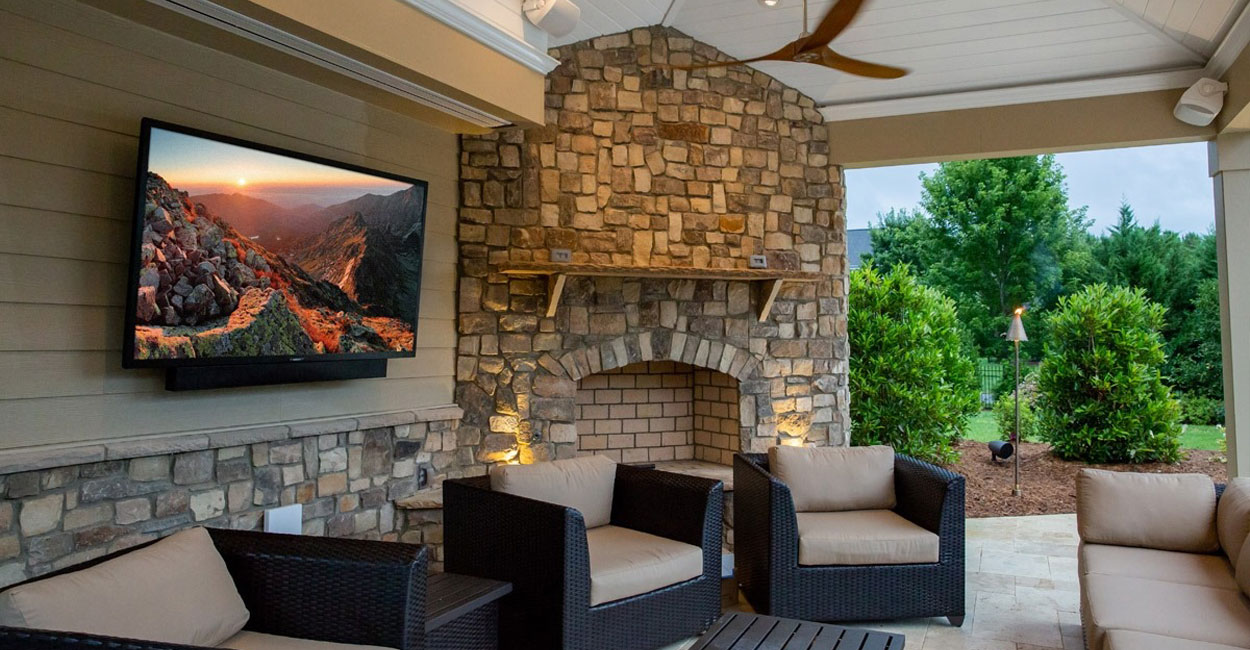
The gold standard for daytime outdoor viewing is a high-brightness, full-sun-rated display. Brands like SunBriteTV (Veranda and Pro 2 series) and Séura produce panels rated at 2,000 to 3,000 nits of brightness, compared to the 300-500 nits typical of an indoor TV. That difference is what makes text legible and colors vivid even at noon in July.
These displays also feature sealed enclosures rated to IP55 or higher, internal heating elements for cold climates, and anti-glare coatings that reduce reflections without sacrificing contrast. A 75-inch full-sun display from Séura, for example, operates reliably in temperatures from -40°F to 140°F. Mounting hardware should be marine-grade stainless steel, and the installation should include proper ventilation space behind the unit to prevent heat buildup against stone or stucco surfaces.
Large-Scale Projection Systems for Evening Galas
For evening events, projection offers a scale that flat panels can’t match. A 150-inch or larger image transforms a pavilion wall or a motorized outdoor screen into a private cinema. Laser projectors from Sony (the VPL-XW7000ES, for instance) or Epson’s Pro Cinema line deliver 4K resolution with HDR and enough lumens to produce a vibrant image even before full darkness.
The projector itself should be housed in a weatherproof, ventilated enclosure, and the screen should be a motorized model that retracts when not in use to avoid UV degradation and wind damage. Ambient light rejecting (ALR) screen materials from Screen Innovations or Stewart Filmscreen can push the usable window earlier into the evening, starting projection while there’s still twilight glow on the horizon.
Immersive Architectural Audio Landscapes
Sound behaves completely differently outdoors. Without walls and ceilings to contain and reflect it, audio dissipates rapidly. A speaker that fills a 400-square-foot room with ease might sound thin and distant from 20 feet away on an open patio. Professional outdoor audio design accounts for this by using more speakers at lower individual volumes, creating an even field of sound rather than relying on a couple of loud point sources.
Strategic Acoustic Design for Even Sound Distribution
The approach that works best for expansive outdoor areas is distributed audio. Instead of two large speakers blasting from one end of the patio, eight to twelve landscape speakers placed strategically around the perimeter create consistent coverage at comfortable listening levels. Brands like Paradigm, MartinLogan, Origin Acoustics, and James Loudspeaker offer weather-rated models disguised as rocks, planters, or bollard lights that virtually disappear into the landscape.
Speaker placement follows the inverse square law: doubling the distance from a speaker drops the perceived volume by about 6 dB. A professional integrator uses acoustic modeling to determine exact placement, aiming for no more than a 3 dB variation across the listening area. The result is whether you’re at the bar, the dining table, or the pool edge, the music sounds balanced and present without being intrusive.
Subterranean Subwoofers for Deep, Discreet Bass
Low-frequency sound is omnidirectional and travels well, which makes it both easier and trickier to manage outdoors. A buried subwoofer, like the Paradigm Garden Oasis series, sits below grade with only a mushroom-shaped waveguide visible above ground level. It pressurizes the air near the listening area and provides the visceral bass foundation that landscape speakers alone can’t reproduce.
Placement typically targets the center of the primary seating zone, and the sub is paired with a dedicated amplifier channel so that bass levels can be adjusted independently of the satellite speakers. For larger properties, multiple buried subs create overlapping bass zones that prevent the “bass cliff” effect that occurs when the low-frequency then disappears as you move away from a single source.
Sophisticated Lighting and Climate Automation
Lighting and climate control are where outdoor technology stops being about entertainment and starts being about comfort and atmosphere. The right lighting design makes a space feel intimate or dramatic on command. Climate automation extends the usable season of an outdoor room by months, turning a three-season patio into a year-round living space.
Intelligent Scene Presets for Transitioning from Dusk to Night
A well-programmed lighting system doesn’t just turn on and off. It transitions. As the sun sets, landscape path lights gradually brighten. Overhead string lights or pendant fixtures in the pavilion warm from a subtle 2200K glow to a slightly brighter 2700K as ambient light fades. Accent lighting on architectural features or plantings activates on a schedule tuned to the local sunset time, which shifts automatically throughout the year.
Systems from Lutron (HomeWorks QSX or RadioRA 3) or Ketra offer this level of precision, with tunable white and full-color LED fixtures that can be grouped into scenes. A “dinner party” scene might bring the table lighting up to 60%, dim the perimeter to 30%, and set the pool lights to a slow color fade. A “movie night” scene kills everything except low pathway lighting and the screen’s bias illumination. These presets activate from a wall keypad, handheld remote, or a single tap on a Control4 interface.
Automated Shade and Radiant Heating Integration
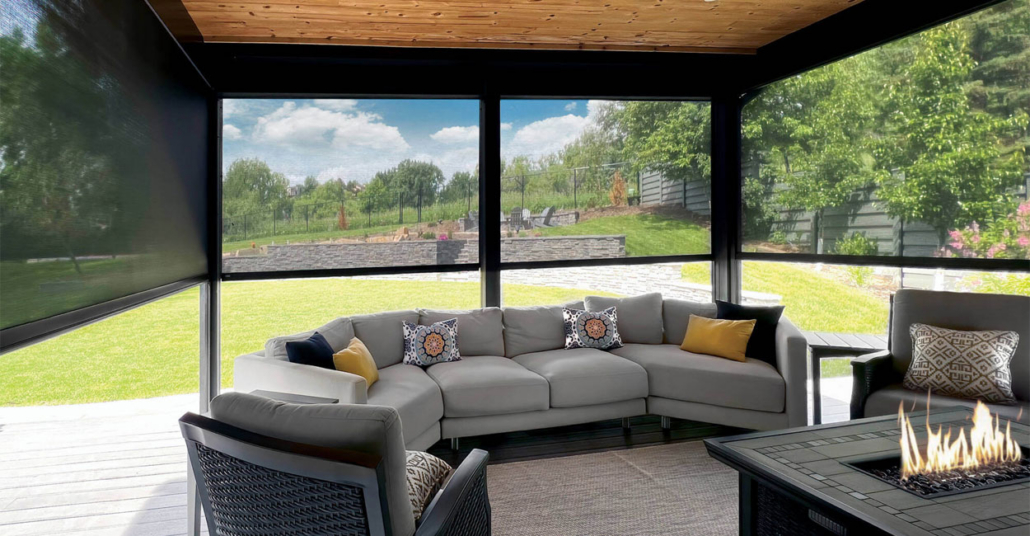
Motorized shade structures from Lutron extend the comfort window on both ends. During the day, they block direct sun and reduce surface temperatures under the pavilion by 15-20°F. In the evening, they retract to open up sightlines and stargazing.
Radiant heating, whether infrared panels or gas-fired radiant systems, can be tied into the same automation platform. Temperature sensors trigger heating automatically when conditions drop below a set threshold, and the system can be overridden manually from the same control interface that manages audio, video, and lighting. The integration means nobody has to get up from the table to adjust anything: the environment adapts around the guests.
Unified Control Systems for Effortless Management
All of this technology, network, video, audio, lighting, shading, and HVAC creates real complexity, and user complexity is the enemy of enjoyment. If your guests need a tutorial before they can change the music or dim the lights, the system has failed, no matter how impressive the hardware.
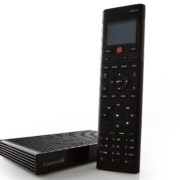
That’s why a unified control platform is non-negotiable for serious outdoor installations. Systems like Control4 (now Snap One) consolidate every subsystem into a single interface. One touch on an in-wall panel, your phone, or a weatherproof tabletop remote can simultaneously start music in the pool zone, lower the pavilion shades, set the lighting to an evening scene, and power on the outdoor display.
The best control systems also handle the things you shouldn’t have to think about. They power down the projector and retract the screen if rain is detected by an integrated weather station. They lower shade structures when wind speed exceeds a safe threshold. They send a notification to your phone if an outdoor amplifier goes offline. This kind of proactive automation is what separates a collection of expensive gadgets from a genuinely intelligent outdoor environment.
Voice control through platforms like Josh.ai (which prioritizes privacy over data harvesting, unlike consumer voice assistants) adds another layer of convenience. Saying “Good evening, patio” can trigger an entire sequence of events without reaching for a remote or a phone.
From Concept to Control
The difference between outdoor tech that impresses and outdoor tech that disappoints almost always comes down to design and integration. Individual components matter, but the real magic is in how they work together: how the lighting responds to the time of day; how the audio fills the space evenly; how the network supports everything without a single dropout. That kind of result requires a team that understands both the technology and the unique demands of exterior environments.
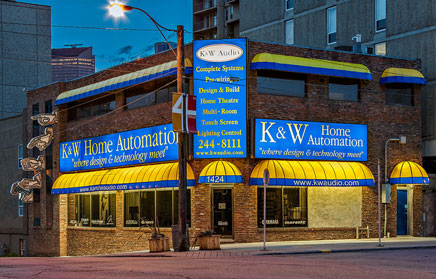
If you’re serious about extending your home’s technology from the patio to the pavilion, K&W Audio is the kind of partner worth talking to. Their team specializes in designing and installing complete outdoor systems, from high-fidelity audio and private cinema systems, to full lighting and climate automation, all tailored to how you actually use your space. Visit K&W Audio to start a conversation about your outdoor living space and what it could become.